


Venezuelan President Nicolás Maduro and his wife Cilia Flores arrived in New York Saturday evening, where they will be arraigned on federal charges of conspiring in narco terrorism, cocaine trafficking, and possession of machine guns.
Trump’s arrest of Maduro and his wife clearly violates international laws. But Trump justifies his actions based on a craft memo written in 1989 by William Barr, then-Assistant Attorney General under President George H.W. Bush. Barr’s opined that opined the FBI has authority to arrest individuals abroad under the U.S. Constitution’s presidential powers. But admittedly ignored international customs and treaties to get there.
The Spectacle of Trump’s Illegal Arrest of Maduro
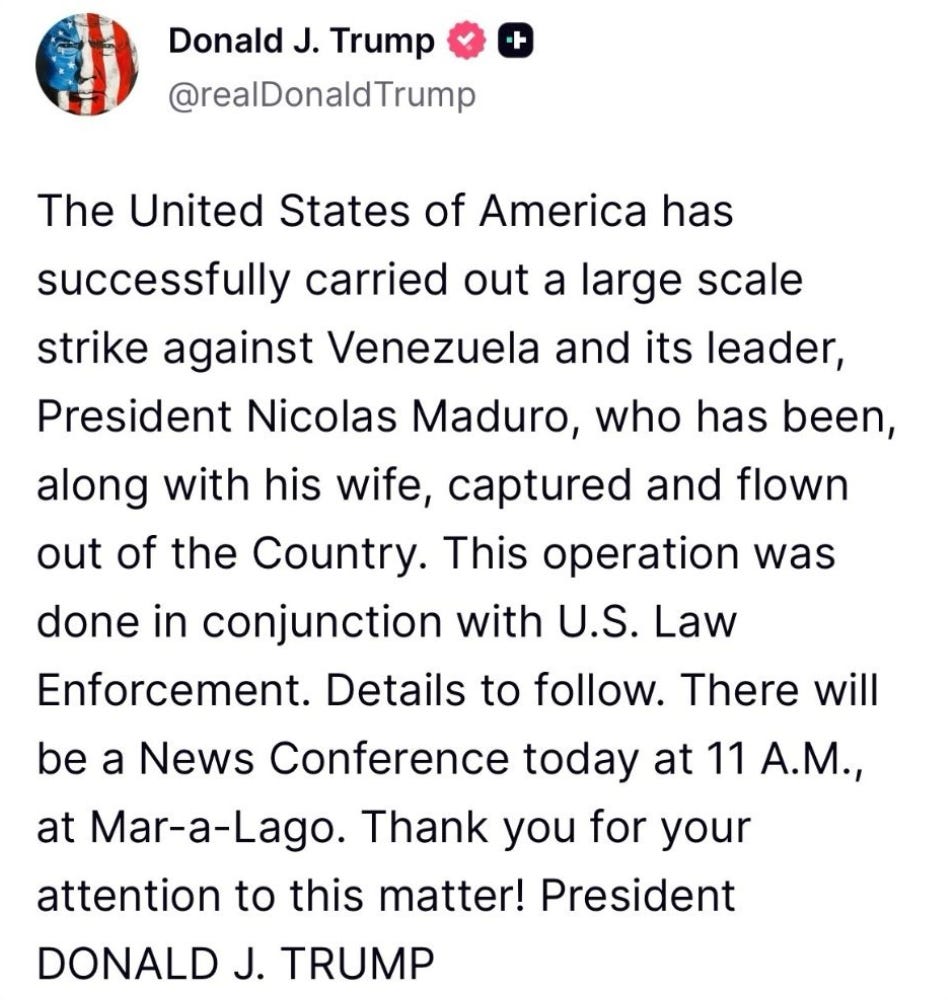
Early this morning, following U.S. Military strikes in Caracas, Trump announced on his Truth Social platform that the U.S. law enforcement had “captured” Nicolás Maduro and his wife Cilia Flores and flew them out of the country. They were taken aboard a U.S. Special Forces MV-22B Ospreys, CH-53E Super Stallion, and AH-1Z attack helicopters were spotted across the Caracas skyline around 2:00 am local time.
“The word integration does not explain the sheer complexity of such a mission, an extraction so precise it involved more than 150 aircraft launching across the western hemisphere in close coordination, all coming together in time and place to layer effects for a single purpose, to get an interdiction force into downtown Caracas while maintaining the element of tactical surprise,” Chairman of the Joint Chiefs of Staff Gen. Dan Caine said.
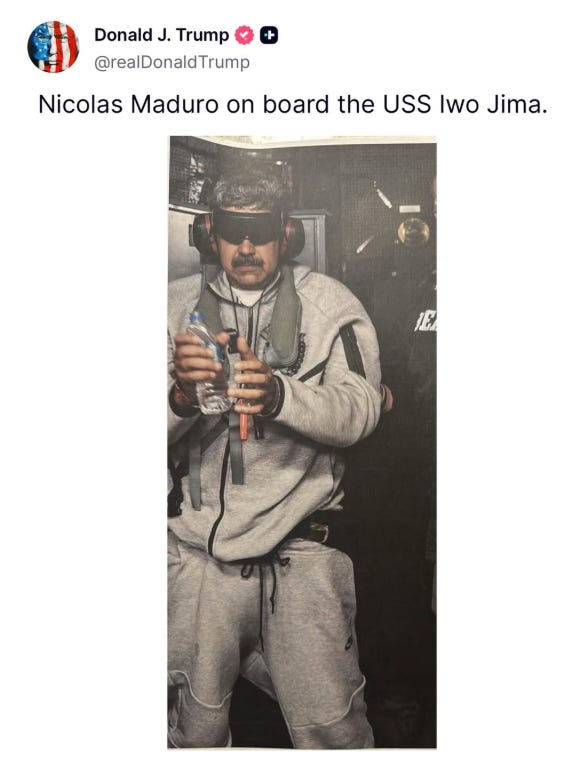
Maduro and his wife were dropped off on the USS Iwo Jima, an aircraft carrier positioned in the Caribbean.
From there, they departed on the DOJ’s 757 which arrived in New York at Stewart Air National Guard Base. From there, Maduro and his wife were transported by helicopter to New York City where they were booked around 7 pm. Maduro and his wife are being detained at Metropolitan Detention Center in Brooklyn.
Maduro and his wife will likely be arraigned on Monday morning at the Daniel Patrick Moynihan U.S. Courthouse in Manhattan.
The Grand Jury’s Charges against Maduro
This morning, the DOJ unsealed an indictment against Maduro and his family, issued by a federal grand jury in the Southern District of New York. The indictment contains sweeping allegations against Maduro and his family for conspiring with the FARC, ELN, Sinaloa Cartel, the Zetas, and Tren de Argua (TdA), to import cocaine to the United States.
Federal prosecutors in the Southern District of New York convinced a secret grand jury that there was probable cause that Maduro, his wife, son, and other Venezuelan officials had violated U.S. law. This morning, the DOJ unsealed the indictment which contains four charges and requests forfeiture of all assets obtained therefrom:
Narco Terrorism Conspiracy—violations of 21 USC § 960a: Providing pecuniary value to terrorist organizations through drug distribution.
Cocaine Importation Conspiracy—violations of 21 USC §§ 952(a), 959(c), 960(a)(1), 960(a)(3), 960(b)(l)(B), 963, and 18 USC § 3238: Importation of at least five kilograms of cocaine into the U.S.
Possession of Machine Guns and Destructive Devices—18 USC §§ 924(c)(l)(A), 924(c)(l)(B)(ii), 3238: Knowingly using and carrying heavy weaponry, including machine guns, in furtherance of drug crimes.
Conspiracy to Possess Machine Guns and Destructive Devices—18 USC §§ 924(c): Agreeing to use machine guns and destructive devices to protect the drug trade.

Maduro and his wife Cilia will be held in federal custody in New York City and arraigned on the charges. Prosecutors will likely extend a plea agreement to Maduro. Upon arraignment, they will likely plead not guilty. Thereafter, they will have time to strike up a plea deal with U.S. Attorneys. But Maduro will most likely maintain his innocence and take his chances before a jury. This will require prosecutors to prove beyond a reasonable doubt that Maduro, his wife, and the other defendants committed every element of each charged offense.
Despite the large scale spectacle orchestrated by Trump and his DOJ, Maduro and his wife are considered innocent until proven guilty by a jury.
This is Maduro’s second indictment. He was previously indicted in 2020 under Trump’s first administration.
Then Attorney-General William Barr held a press conference on March 26, 2020, about the first indictment. “As alleged, the Maduro regime is awash in corruption and criminality. Maduro and the other defendants have betrayed the Venezuelan people and corrupted Venezuela’s institutions. While the Venezuelan people suffer, this cabal lines their pockets with drug money and the proceeds of their corruption. This has to come to an end.” Barr said.
In the 2020 indictment, Maduro was charged with the same crimes. One of the most significant differences betwen the 2020 and 2025 indictments are the defendants.
In 2020, Nicolás Maduro, Diosdado Cabello Rondón, El Pollo, Ivan Marquez, and Jesús Santrich were indicted.
Whereas in 2025, Nicolás Maduro, Diosdado Cabello Rondón, Ramon Chacin, Cilia Flores, Nicolasito (Maduro’s son), and Niño Guerrero (leader of Tren de Aragua) were indicted.
Trump’s Justification for Ignoring International Law
The U.S. has justified its 2026 operation by relying on a controversial 1989 legal memo written by then-Assistant Attorney General William Barr. The Barr Memo advocates for broad executive privileges and that the U.S. President has power to unilaterally remove officials while resisting Congressional oversight.
In 1980, the Office of Legal Counsel, under the Carter administration, released an opinion that the FBI lacked authority under 28 U.S.C. § 533(1) to apprehend and abduct a fugitive residing in a foreign state when those actions would be contrary to customary international law.
Nearly a decade later, the FBI requested reconsideration of the 1980 opinion. And Barr drafted his infamous 1989 legal memo, which provided a completely different authority—authorizing the FBI to arrest individuals abroad without the consent of a foreign jurisdiction.
The 1989 Barr Memo contains the following major conclusions about the FBI’s authority under the President’s power, to arrest individuals abroad:
At the direction of the President or the Attorney General, the FBI may use its statutory authority to investigate and arrest individuals for violating United States law, even if the FBI’s actions contravene customary international law.
The President, acting through the Attorney General, has the inherent constitutional authority to deploy the FBI to investigate and arrest individuals for violating United States law, even if those actions contravene customary international law.
Extraterritorial law enforcement activities that are authorized by domestic law are not barred even if they contravene unexecuted treaties or treaty provisions, such as Article 2(4) of the United Nations Charter.
An arrest that is inconsistent with international or foreign law does not violate the Fourth Amendment.
Barr testified about his memo before Congress. Barr’s memo admittedly ignored implications of deploying the FBI in violation of customary international law and treaties.
Prior to Barr’s memo and testimony about it before Congress in 1989, a 1980 opinion stated the FBI had no authority under 28 U.S.C. § 533(1) to apprehend and abduct a fugitive residing in a foreign state when those actions would be contrary to customary international law.”
Immediately following the Barr Memo’s internal release, the U.S. invaded Panama in Operation Just Cause. Noriega, the de facto ruler, was captured and brought to the U.S. to face drug trafficking and racketeering charges.
In 1999, Slobodan Milošević, U.S. and NATO forces targed the Serbian leaders residence with laser bombs. In 2003, during the Iraq War, U.S. special forces relied on the Barr Memo to capture Sadam Hussein. In 2011, under the Obama administration, Osama bin Laden, leader of Al-Qaeda, was killed during a Navy Seal raid in Abbottabad. In 2011, Muammar Gaddafi was killed by U.S. backed rebel forces. In 2020, under the first Trump administration, Qasem Soleimani, a high-ranking Iranian general was skilled by a U.S. drone strike at Baghdad International Airport under the Trump administration.
The Barr Memo remains the primary legal justification for these "extraterritorial law enforcement" actions, asserting that the President’s domestic authority to enforce U.S. law outweighs the constraints of the UN Charter or foreign sovereignty.
Trump’s Violations International Law
The Barr Memo ignored customary international and treaties ratified by the United States, including the UN Charter.
Violations of Article 2(4) of the UN Charter
This article prohibits the “threat or use of force against the territorial integrity or political independence of any state”. Multiple nations, including France and Mexico, have explicitly cited this as a violation.
The UN “is based on the principle of the sovereign equality of all its Members.”1
Article 2(4) of the UN Charter provides:
All Members shall refrain in their international relations from the threat or use of force against the territorial integrity or political independence of any state, or in any other manner inconsistent with the Purposes of the United Nations.
The UN Charter was signed on June 26, 1945, in San Francisco, at the conclusion of the United Nations Conference on International Organization. The charter became binding on October 24, 1945.
Violations of Non-Intervention
Customary international law prohibits states from intervening in the internal affairs of another sovereign nation. Heads of state typically enjoy personal immunity (ratione personae) from the criminal jurisdiction of other states.
Violations of Inviolability
This immunity is intended to ensure that leaders can perform their duties without fear of arrest or detention by foreign powers.
The Noriega Precedent
U.S. Courts have historically ruled that the executive branch’s refusal to recognize a leader’s legitimacy (as the U.S. has done with Maduro) allows them to bypass these immunity claims in domestic courts, though this remains highly controversial under international law. The Noreiga precedent is often rationalized by the 1989 Barr Memo.
Forced Abduction is a Dangerous Precedent
The capture and removal of Maduro sets a dangerous precedent for other global powers to ignore international law and intervene in neighboring states. UN experts consider it an “illegal aggression.” International law generally requires an extradition treaty and a formal legal process to move a suspect from one country to another. While U.S. domestic law (under the Ker-Frisbie doctrine) often allows courts to try a defendant regardless of how they were brought to the country, international law often views such “irregular renditions” as a breach of the territorial integrity of the home state. International critics, including France’s foreign minister, have stated that the capture violates the right of the Venezuelan people to self-determination. They argue that no lasting political solution can be imposed from the outside and that only the sovereign people of a nation should decide their future.
This evening, U.S. Representative Eric Swalwell was asked by CNN whether the DOJ lawfully captured Maduro. “Absolutely Not,” Eric Swalwell said. He questioned why Benjamin Netanyahu has not been arrested for war crimes.
On November 21, 2024, the International Crimes Court issued an arrest warrant for Benjamin Netanyahu. Prior to the U.S.’s strike on Caracas, Netanyahu met with Trump at Mar-a-Lago, where they celebrated the New Year.
UN Charter, Article 1(4).