


IRAN—The geopolitical landscape of the Middle East has been irrevocably altered by two criminals who have control over the U.S. Military: President Donald J. Trump—a convicted felon and rapist—and Benjamin Netanyahu currently under an arrest warrant for war crimes including starving citizens to death in Palestine.
The United States and Israel in joint Operation Epic Fury carried out widespread attacks in Iran on Saturday morning and assassinated its Supreme Leader Ayatollah Ali Khamenei (علی خامنهای).
The attacks violate international law including the United Nations Charter, former President Ronald Reagan’s executive order prohibiting assassinations, and exceed the powers afforded to presidents under Article II of the United States Constitution. Even the most conservative jurists who demand strict interpretation of the law cannot deny it with a straight face, Article I is clear: only Congress has the power to declare war. Not President Trump. Yet by Sunday, Trump declared war against Iran.
The U.S. and Israel attacked Iran during peace negotiations
The attack did not occur in a vacuum. In the days leading up to the attack, a flurry of diplomatic activity suggested a potential breakthrough in negotiations among the conflicting nations.
On Thursday, Benjamin Netanyahu’s godson Jared Kushner and Steve Witkoff, a billionaire real estate developer appointed by President Trump as special envoy to the Middle East, met in Geneva with de facto mediator Omani Foreign Minister, Sayyid Badr Albusaid, to negotiate with Iran.
Neither Kushner nor Witkoff has any prior experience in the State Department, military, or foreign service. Both men are rife with financial conflicts and continue self-enrich themselves by exploiting the U.S. Military and the ongoing conflicts in the Middle East.
The Witkoff Group, Inc. was in financial ruin during the first Trump administration only to be bailed out by the Qatari government which provided heavily funding.
The Qatar Investment Authority (QIA) purchased the Park Lane Hotel in Manhattan from the Witkoff Group for $623 million in 2023, a deal that helped Steven Witkoff exit a heavily indebted investment. Additionally, in 2025, the Witkoff Group received $100 million from the Apollo Trust, a fund partly owned by Qatar, for a project in Palm Beach.
In 2021, Jared Kushner created the private equity firm Affinity Partners—mostly funded by the Saudi government.
Since returning to the White House in 2025, Kushner has served with Witkoff in diplomatic negotiations over the Gaza War and Russia’s invasion of Ukraine.
During last week’s negotiations, Kushner and Witkoff demanded Iran dismantle its nuclear sites at Fordow, Isfahan, and Natanz. Iran maintains its nuclear program is aimed at production of power for civilian purposes not weapons.
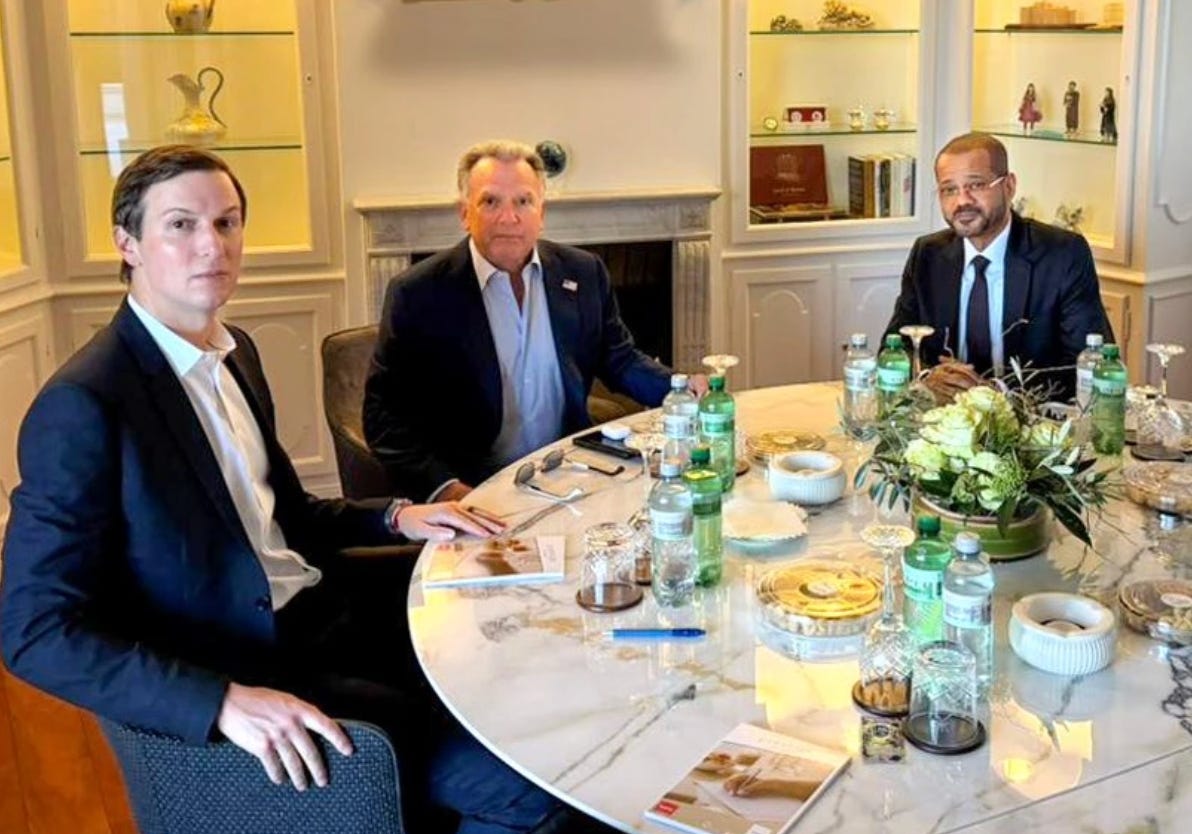
On Friday, Iran’s Foreign Minister, Abbas Araghchi, joined the negotiations. He noted negotiations were the “most intense so far.” The U.S., Israel, and Iran were planned to resume negotiations on Monday in Vienna, Austria.
U.S. and Israel launch a surprise attack on Iran
Although the countries were scheduled to continue negotiations with Iran on Monday, the U.S. and Israel stunned Iran with a massive surprise attack on Saturday morning.
Trump’s administration described the strikes as a “pathway to diplomacy.”
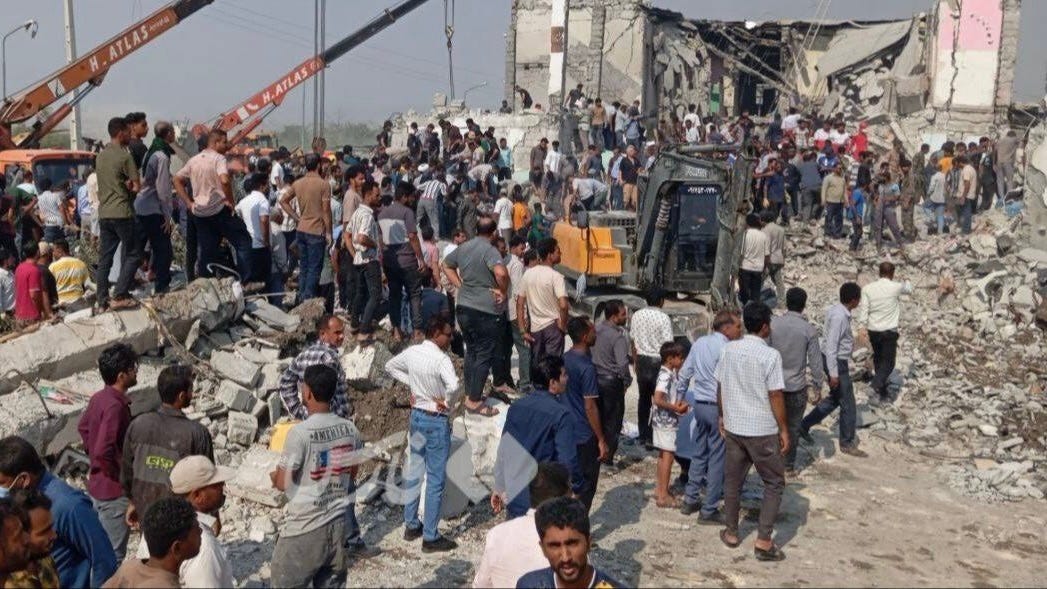
On Saturday morning, the Minab school, an all-girls primary school in Southern Iran, was bombed. 115 girls between the ages seven and 12 were killed.
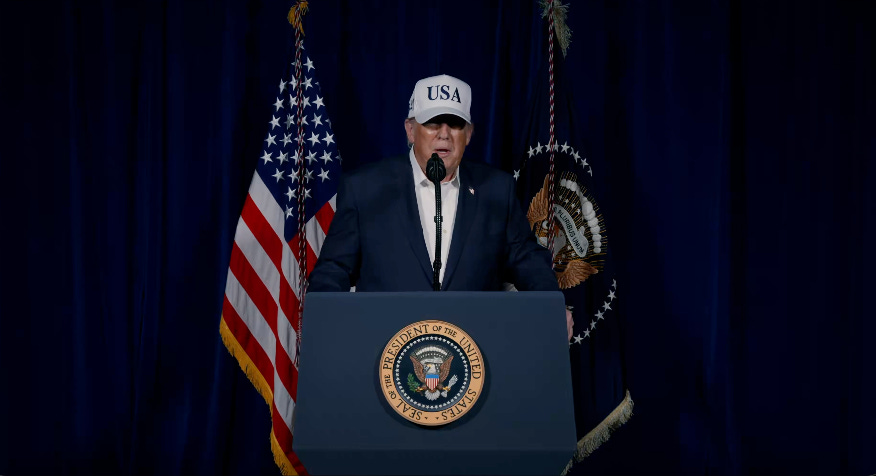
Trump speaking from Mar-a-Lago attempts to sell the attack to Americans
Saturday afternoon, President Trump attempted to market the war to his highly susceptible and easily manipulated supporters. Trump spoke from a podium in Florida at his luxury residence Mar-a-Largo, valued at over $1 billion. Trump wore a white trucker hat with embroidered with “USA.”
In the eight minute speech, Trump deployed his typical rhetoric and hyperbole that has effectively persuaded his followers over the last decade. To that end, he frequently misstated the history of conflicts in the Middle East, omitted critical history, and spoon-fed simple phrases to his followers who typically lack the appetite for complexities.
Trump argued that for “47 years, the Iranian regime has chanted ‘Death to America’ and waged an unending campaign of bloodshed and mass murder, targeting the United States, our troops, and the innocent people in many, many countries.” Trump argued the Iranian regime only wanted to “practice evil.”
Trump’s simplistic characterization of nearly five decades of history lacked context and was used to further manipulate his followers to justify the military action that continues to financially enrich Trump and cronies.
“It’s been mass terror, and we’re not going to put up with it any longer.” Trump said. Ultimately, Trump provided no justification under international law for the U.S. and Israel to use force against Iran.
Trump and Netanyahu announce the killing of Ayatollah Ali Khamenei
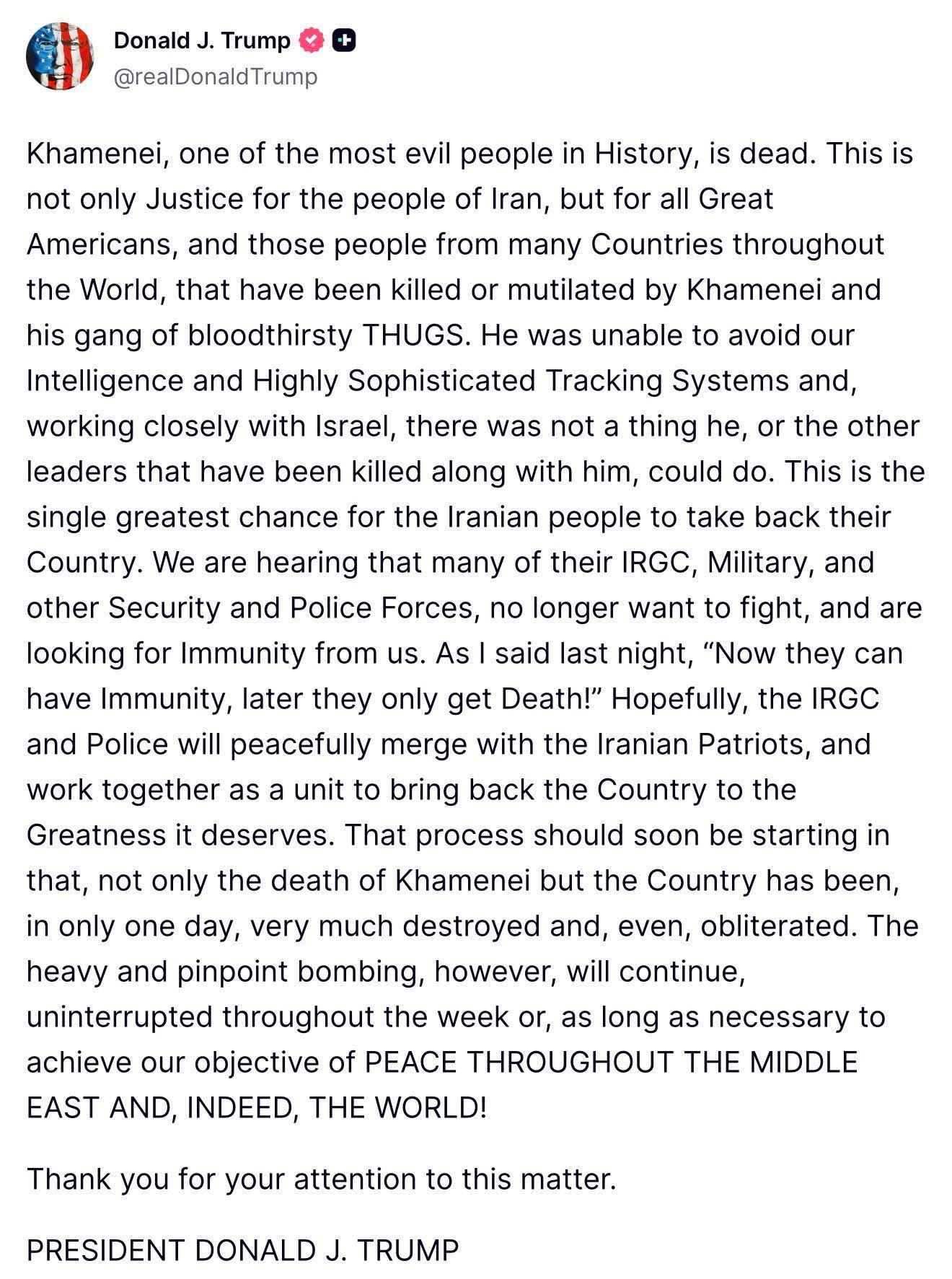
Later on Saturday, Netanyahu claimed Khamenei was dead. Trump announced on his privately owned social media platform Truth Social that Khamenei was killed.1
“He was unable to avoid our Intelligence and Highly Sophisticated Tracking Systems and, working closely with Israel, there was a not a thing he, or the other leaders that have been killed along with him, could do,” Trump wrote.
Israeli video depicts the bombing of Khamenei’s home.
The Israeli Army released aerial footage showing Khamenei’s home exploding. Presumably he was killed in the blast. The video evidences an intentional, premeditated, planned assassination—a clear violation of the UN Charter.
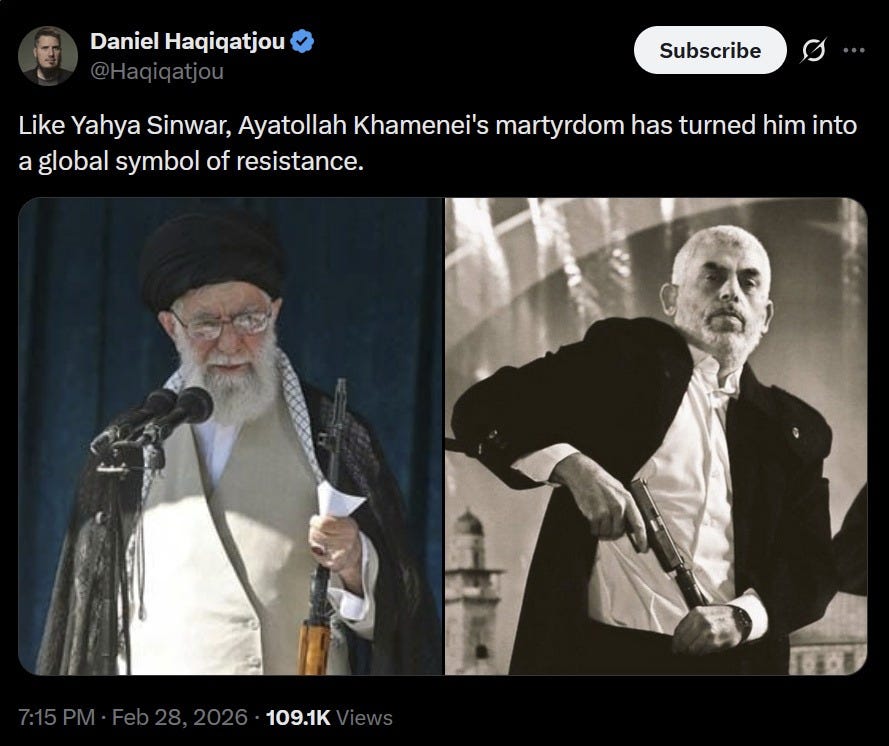
American Muslim writer Daniel Haqiqatjou criticized that the killing “has turned [Khamenei] into a global symbol of resistance.”
Iran’s President Masoud Pezeshkian characterized the killing of Khamenei as a “declaration of war against Muslims.”
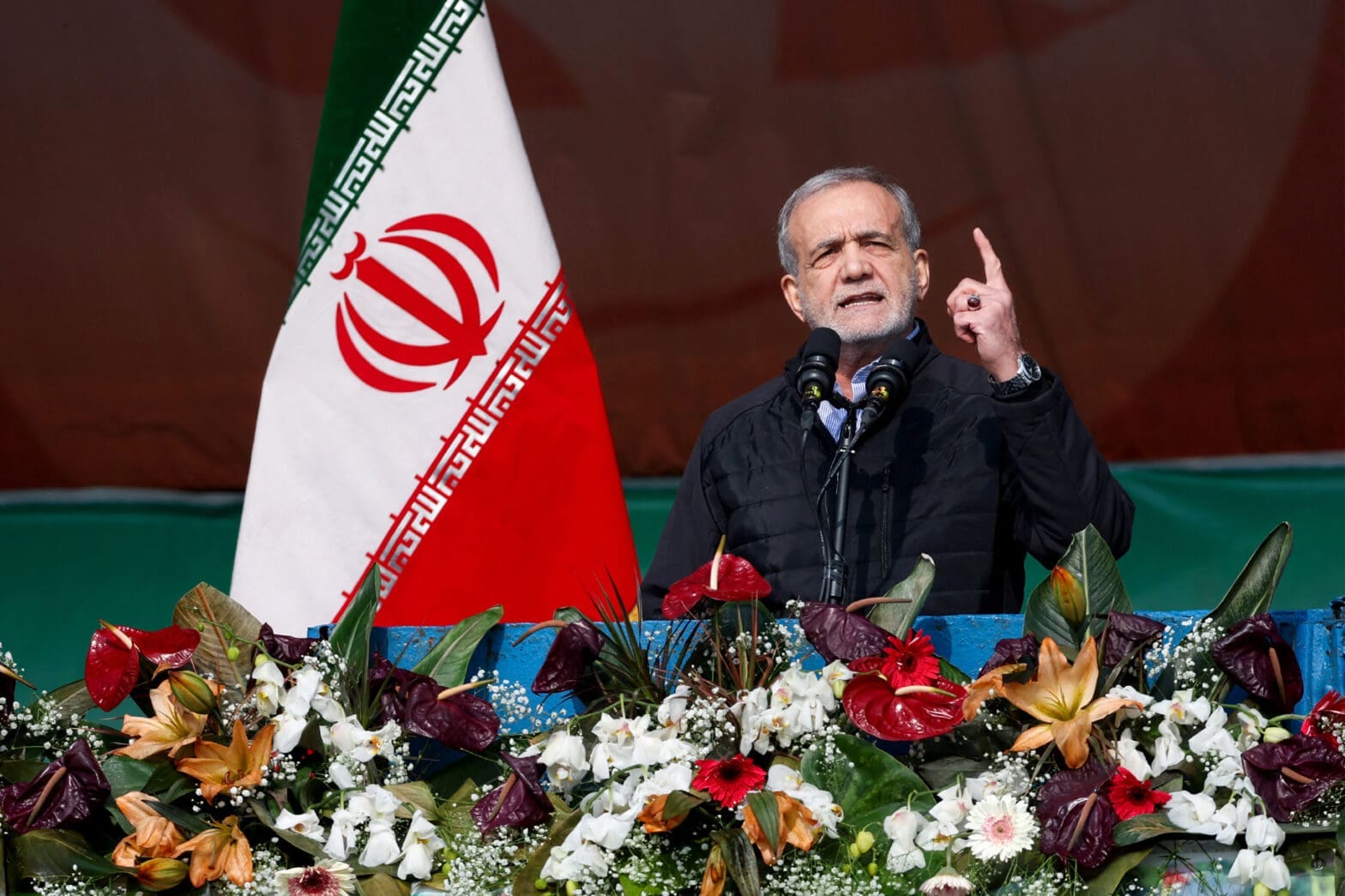
“The assassination of the highest political authority of the Islamic Republic of Iran and a prominent leader of Shiism worldwide… is perceived as an open declaration of war against Muslims, and particularly against Shiites, everywhere in the world,” Pezeshkian said.
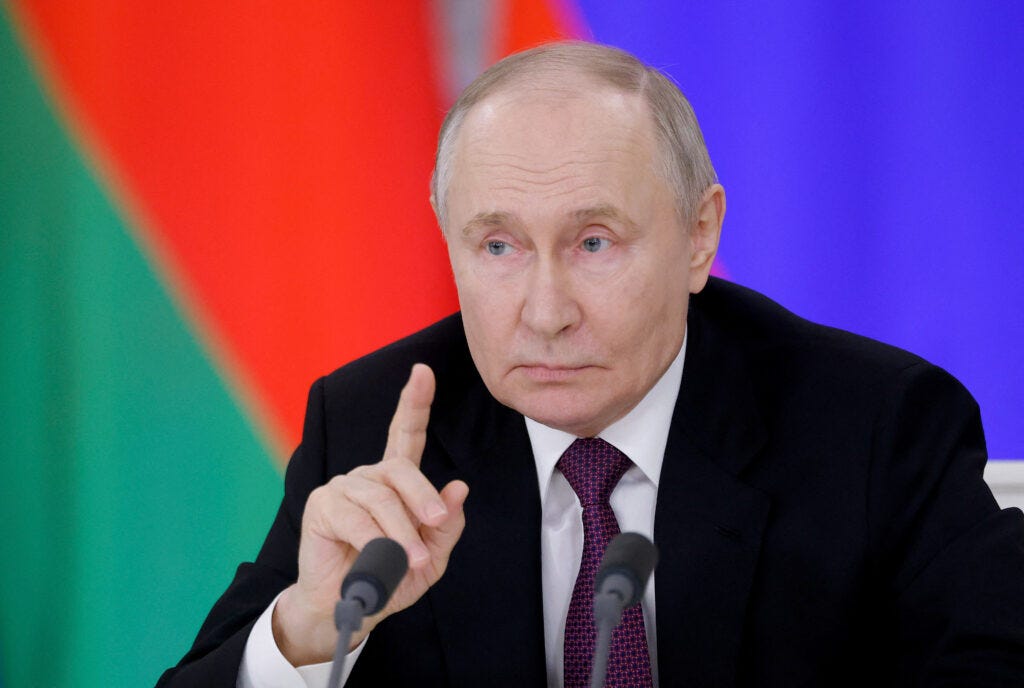
Russian President Vladimir Putin responded. "The assassination of Iranian Supreme Leader is a brutal murder that violates all ethics and international law." Putin said.
The Russia Federation is one of the five permanent members of the United Nations Security Council (UNSC). Russia has been highly critical in the UN of Israel’s war crimes.
Trump has been deeply critical of the UN and sought to undermine its authority, including by failing to pay nearly $4 billion dollars in debt the U.S. owes to the UN. Trump has referred to the UN as a “con job” because it does not support his approach to immigration and energy policies. In 2026, Trump created the “Board of Peace” at the 56th World Economic Forum as his own alternative to the UN. Participating countries are required to contribute $1 billion every three years. To date, there are 22 member states of the Board of Peace, including Israel. Iran is not a member. Trump believes his Board of Peace could replace the UN. There are currently 193 member states to the UN Charter.
The UN Charter prohibits use of force except in cases of “self-defense”
Trump and Netanyahu have consistently used force throughout the Middle East that clearly violates the UN Charter. They have frequently attempted to undermine and usurp the UN to avoid the consequences of their war crimes. In 2024, the International Criminal Court (ICC) issued an arrest warrant for Netanyahu for using starvation as a method of murdering civilian populations in Palestine.2
The core purpose of the United Nations is to maintain international peace. Member nations, including the U.S., Israel, and Iran, are prohibited under Article 2(4) from using force:
Article 2(4) prohibits all members from the threat of force against the territorial integrity or political independence of any state. Specifically, Article 2(4) provides:
All Members shall refrain in their international relations from the threat or use of force against the territorial integrity or political independence of any state, or in any other manner inconsistent with the Purposes of the United Nations.
There is one exception: self-defense from an armed attack under Article 51:
Nothing in the present Charter shall impair the inherent right of individual or collective self-defence if an armed attack occurs against a Member of the United Nations, until the Security Council has taken measures necessary to maintain international peace and security. Measures taken by Members in the exercise of this right of self-defence shall be immediately reported to the Security Council and shall not in any way affect the authority and responsibility of the Security Council under the present Charter to take at any time such action as it deems necessary in order to maintain or restore international peace and security.
The White House and its UN Ambassador Mike Waltz argued on Saturday morning at the UN in New York that the U.S. was acting out of self-defense and therefore justified under Article 51. Waltz argued:
The United States has made every effort to negotiate a peaceful resolution of this conflict with Iran, but Iran has failed to take that opportunity. So in close coordination with the Government of Israel, the United States has taken lawful actions to address these threats, in line with Article 51 of the Charter of the United Nations.
And Mr. President, I’ll just say on a final note, you know who is not complaining tonight? You know who is not citing the vagaries of international law? You know who is celebrating in the streets around the world? The Iranian people.
The U.S. was not facing an armed attack
Waltz has grossly misinterpreted Article 51 in defiance of the binding interpretations promulgated by the International Court of Justice (ICJ) and Security Council (UNSC). The ICJ is primarily responsible for interpreting the UN Charter. Whereas the Security Council has authority to determine whether a member state’s unilateral action constitutes “self-defense” under the Charter and to issue sanctions and pass binding resolutions.
Citing Article 51 themselves, Iran labeled the move “blatant military aggression.” Foreign Minister Esmaeil Baghaei warned that the fabric of the UN Charter is at stake, stating, “Any location providing logistical support to the aggressor is a legitimate target.”
Pete Hegseth’s Tweet proves the attacks were not justified under International law
On Saturday, U.S. Department of War, Secretary Pete Hegseth thumped his chest in a lengthy social media post. “The Iranian regime had their chance, yet refused to make a deal — and now they are suffering the consequences,” Hegseth wrote. This proves that the U.S. and Israel did not attack Iran in “self-defense” but because Trump and Netanyahu did not get the deal they wanted.
Lack of imminence
Under the Caroline Test—the gold standard of international law—preemptive self-defense is only legal when the threat is “instant, overwhelming, leaving no choice of means, and no moment for deliberation.” Because the U.S. and Israel had ample time to plan “Epic Fury” and were simultaneously engaged in diplomacy, they clearly fail to meet the strict requirements of imminence necessary to justify the use of force.
Lack of proportionality
Self-defense must be proportional to the injury suffered. As there was no active Iranian kinetic operation against the U.S. mainland or Israel at the time of the strike, the assassination of a Head of State—an act of forced regime change—arguably exceeds the legal bounds of repelling an attack.
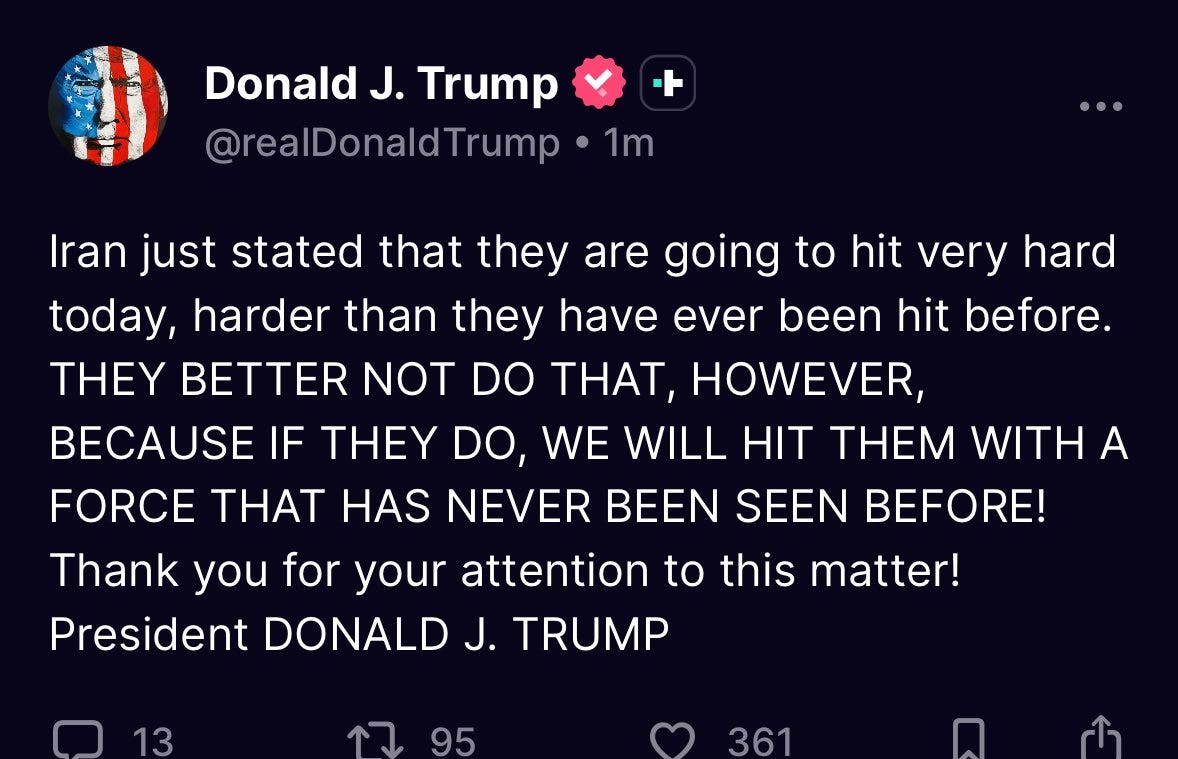
By Sunday, President Trump posted on social media that if Iran hits harder than they have ever hit before, then the U.S. “will hit them with a force that has never been seen before!” This implies a U.S. response will be more than proportional.
Reagan’s Executive Order 12333 prohibits assassinations
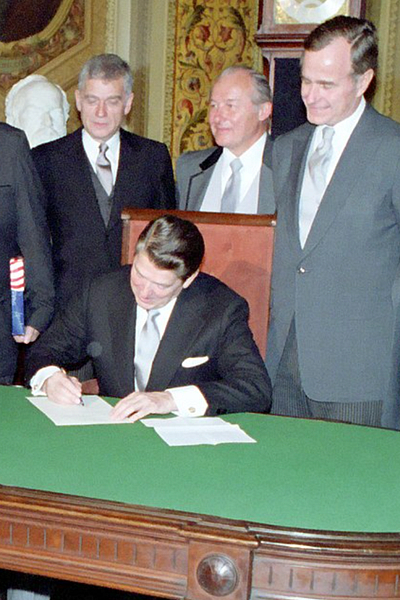
In 1981, President Ronald Reagan signed Executive Order 12333, explicitly stating: “No person employed by or acting on behalf of the United States Government shall engage in or conspire to engage in assassination.” While the Office of Legal Counsel (OLC) argues that “targeted killings” of “lawful military targets” are exempt, the assassination of a sovereign leader during peacetime negotiations is a clear violation of the spirit of the order.
“Assassination” as defined by Oxford English Dictionary:
The murder of a person (esp. a prominent public figure) in a planned attack, typically with a political or ideological motive, sometimes carried out by a hired or professional killer; a murderous attack of this kind.3
The term assassination originated from the Hashīshīn, a 12th Century Shia Muslim sect in the Middle East infamously known for getting high from hashish and murdering its opponents.
Trump’s attack violates the United States Constitution Article II on Separation of Powers
The United States Constitution provides for a separation of powers among the Executive, Legislative, and Judicial branches of the federal government. Article II vests President Trump with the executive power and makes him commander in chief of the military.
Article I, Section 8 of the U.S. Constitution provides the Congress with war powers.
To declare War, grant Letters of Marque and Reprisal, and make Rules concerning Captures on Land and Water;
To raise and support Armies, but no Appropriation of Money to that Use shall be for a longer Term than two Years;
To provide and maintain a Navy;
To make Rules for the Government and Regulation of the land and naval Forces;
To provide for calling forth the Militia to execute the Laws of the Union, suppress Insurrections and repel Invasions;
. . .
And
To make all Laws which shall be necessary and proper for carrying into Execution the foregoing Powers, and all other Powers vested by this Constitution in the Government of the United States, or in any Department or Officer thereof.
A strict interpretation of the U.S. Constitution clearly vests war authority in the Congress—not the president. Article II which enumerates the president’s power clarifies this. Article II Section 1, Clause 1 provides:
The executive Power shall be vested in a President of the United States of America.
Article II section 2, clause 1 provides:
The President shall be Commander in Chief of the Army and Navy of the United States, and of the Militia of the several States, when called into the actual Service of the United States; he may require the Opinion, in writing, of the principal Officer in each of the executive Departments, upon any Subject relating to the Duties of their respective Offices, and he shall have Power to grant Reprieves and Pardons for Offences against the United States, except in Cases of Impeachment.
Throughout time, including as a result of the proliferation of the military industrial complex in the United States, most modern presidents have argued that their role as command in chief vests them with inherent authority to direct military actions without formally declaring war.
Since the Korean War, the Executive Branch primarily through its self-serving Office of Legal Counsel (OLC) has rendered legal opinions that not every “military action” constitutes “war.” The OLC has argued that a “war” only exists if a conflict reaches a certain threshold of intensity.
They argue congressional approval is only required based on the nature, scope, and duration of the military action. For example, is the mission limited to merely a drone strike rather than a ground invasion? Does the scope involve a significant risk of high casualties or prolonged engagement? Is it one-off strike?
Regardless of whether you accept this uprooting of the separation of powers and the plain and ordinary requirements in Article I that only Congress has the power to engage in war, the nature, scope, and duration of Operation Epic Fury far exceeds a simplistic military strike.
On Saturday, Pete Hegseth, Secretary of the U.S. Department of War described the attack as “the most lethal, most complex aerial operation in history.”
Ever since the Iraq War, presidents have sought to justify their unilateral military actions in the Middle East by claiming that in 2001 and 2002, the Congress issued memos on the Authorization of the Use Military Force (AUMF) without any expiration. However, the 2001 AUMF was authorization for military force against Al-Qaeda and the Taliban to combat the so-called “Global war on terror.” Not Iran. Presidents attempt to couch any military action in the Middle East as being associated with terror groups. The 2002 AUMF was for the war against Iraq. But presidents still attempt to equivocate the language to rationalize their unapproved and unrelated military actions in the Middle East.
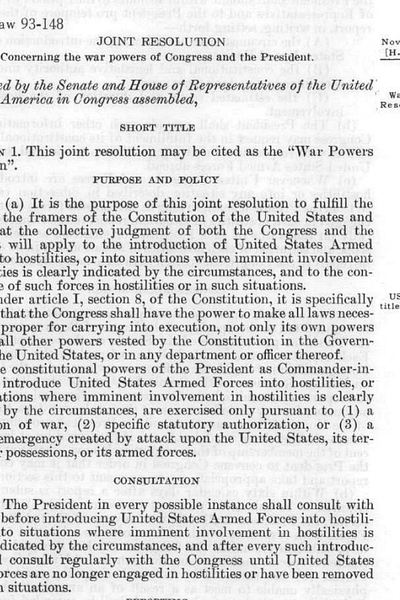
Some argue the War Powers Resolution in 1973 created a loophole. However, the resolution was reated to limit the President from military action. It authorized the President to introduce troops on the ground into hostilities for 60 to 90 days before congressional authorization. Presidents rely on this grace period to conduct short-term strikes and argue congressional approval is unnecessary for the first 90 days. But the Wars Power Resolution was not an amendment to the U.S. Constitution.
Moreover, the resolution only authorizes the introduction of armed forces “into hostilities.” President Trump has not deployed troops on the ground in Iran nor in a any existing hostility.
Presidents also attempt to justify their military actions by arguing their inherent authority as the Commander-in-Chief authorizes them to protect “national interests” without congressional approval. These constitutional interpretations are heavily promulgated by the war industry. In 2024, the top 100 global arms producers generated $679 billion in revenue, with nearly half of that amount or $334 billion flowing to 39 U.S.-based weapons manufacturers.
During Trump’s State of the Union Speech last month, he touted a $1 trillion dollar defense budget. Trump recently proposed a 50 percent increase in the Pentagon’s budget to be implemented in 2027 to build his “dream military.”
Weapon and aerospace defense industry stocks have seen substantial gains over the past year. Shareholders of Cleveland based Sifco Industries, Inc., (SIF) which manufactures metal components used for weapons, has seen a 150.72 percent over the last year. Traditional and new weapons manufactures have realized unprecedented growth and profits during Trump’s first year back in office.
Dangerous territory
By executing Operation Epic Fury in the middle of active diplomatic channels, the United States and Israel have signaled that the "negotiating table" may now serve as a tactical distraction rather than a tool for peace.
If the UN Charter’s prohibitions on the use of force and the domestic bans on assassination are treated as mere "vagaries" of law—as suggested by Ambassador Waltz—the global community enters a volatile new era. In this landscape, the Caroline Test of imminence has been replaced by a doctrine of convenience, and the line between statecraft and state-sponsored killing has been all but erased. As the world waits for Iran’s next move, one thing is certain: the events of February 28 have ensured that diplomacy will never be viewed the same way again.
Update: on Sunday afternoon, Trump spoke again from Mar-a-Lago to announce that the U.S. had taken out nine Iranian navy ships. “The entire military command is gone as well,” Trump said. “They have waged war against civilization itself.” Trump declared while he continued to distort that Iranians are celebrating the surprise attacks and assassination of Khamenei. “We are undertaking this massive operation not only to ensure security for own time and place but for our children . . . This is the duty and burden of a free people.” Trump called the Iranian regime “radical and bloodthirsty . . . wicked extremists.” But Trump’s second speech about the attack was devoid of any evidence justifying under International law the use of force.
Truth Social is a Twitter clone that Trump created after he was banned from Twitter. Trump and owns Truth Social through his company Trump Media & Technology Group, Inc. (TMTG.), a majority of which is owned by the Donald J. Trump Revocable Trust. TMTG went public in 2024 as a special-purpose acquisition group.
https://www.icc-cpi.int/defendant/netanyahu
https://www.oed.com/dictionary/assassination_n?tl=true&hide-all-quotations=true