


In 1998, Ken Starr nearly toppled a president over a lie about sex with an intern. Ten years later, he was writing to the second most powerful official at the Justice Department to argue that Jeffrey Epstein’s sexual abuse of underage girls was merely a “local” matter, one that didn’t warrant a federal prosecution. Three letters, sent in the spring of 2008, show how hard Starr pushed to keep the FBI’s 60-count case against Epstein from ever seeing a courtroom.
The confidential letters reveal Kirkland & Ellis’ Ken Starr1 pressured the DOJ’s No. 2 Official to shut down the federal prosecution of the law firm most famous client: pedophile and child sex trafficker Jeffrey Epstein.
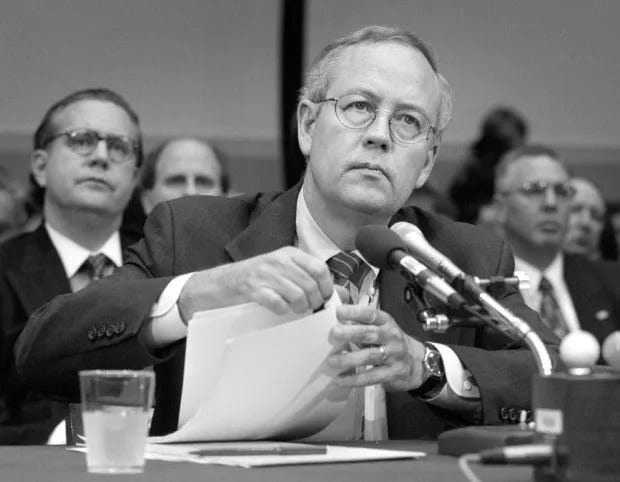
1998 photo of Independent Counsel Kenneth Starr revealing to the House Judiciary Committee his findings that then-President Bill Clinton had lied in a deposition about having “sexual relations” with White House intern Monica Lewinsky. Clinton was impeached.
Palm Beach Police Chief Turns Whistleblower: FBI Investigates
In 2005, the Palm Beach Police Department received a report that Epstein had raped a 14-year-old-girl. Over 13 months, detectives collected volumes of evidence against Epstein and interviewed more than a dozen alleged underage victims.
In 2006, Police Chief Mark Reiter became concerned about how Florida prosecutors were handling the case when they took the unprecedented step of empaneling a state grand jury, which ultimately determined that Epstein should be charged only with soliciting prostitution. (Florida Statute § 796.07.) Chief Reiter reported the issue to the FBI, which launched a broader investigation that eventually made it to the desk of then-U.S. Attorney Alexander Acosta in Miami.
Federal prosecutors draft a 60-count indictment against Epstein
Federal prosecutors worked with two FBI agents who discovered additional victims. In May 2007, an AUSA under Acosta drafted a 60-count indictment against Epstein.
U.S. Attorney Alex Acosta enters a “sweetheart deal” with Epstein
In July 2007, federal prosecutors met with Epstein’s criminal defense team and offered to end their investigation in exchange for his pleading guilty to state charges and serving two years in prison.
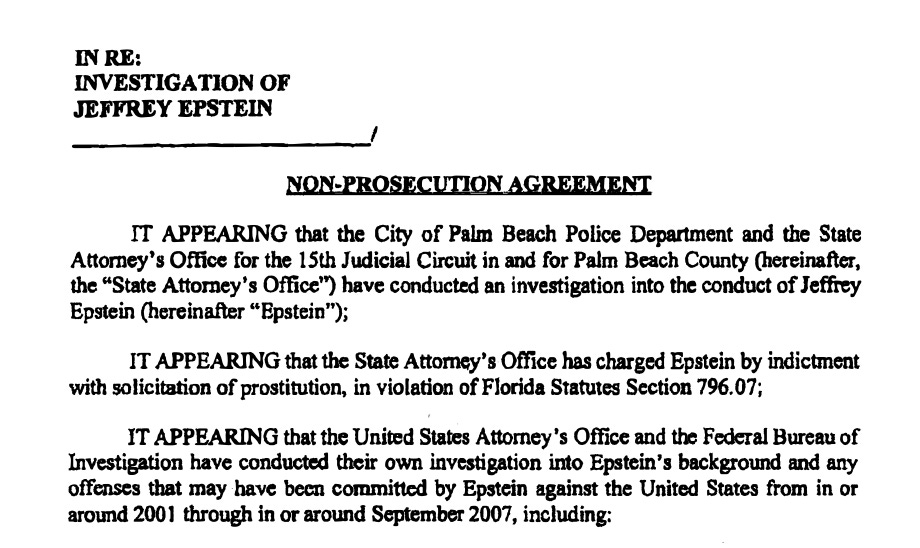
In Sept. 2007, Acosta entered into the so-called “sweetheart deal” or non-prosecution agreement (“NPA”) with Epstein.
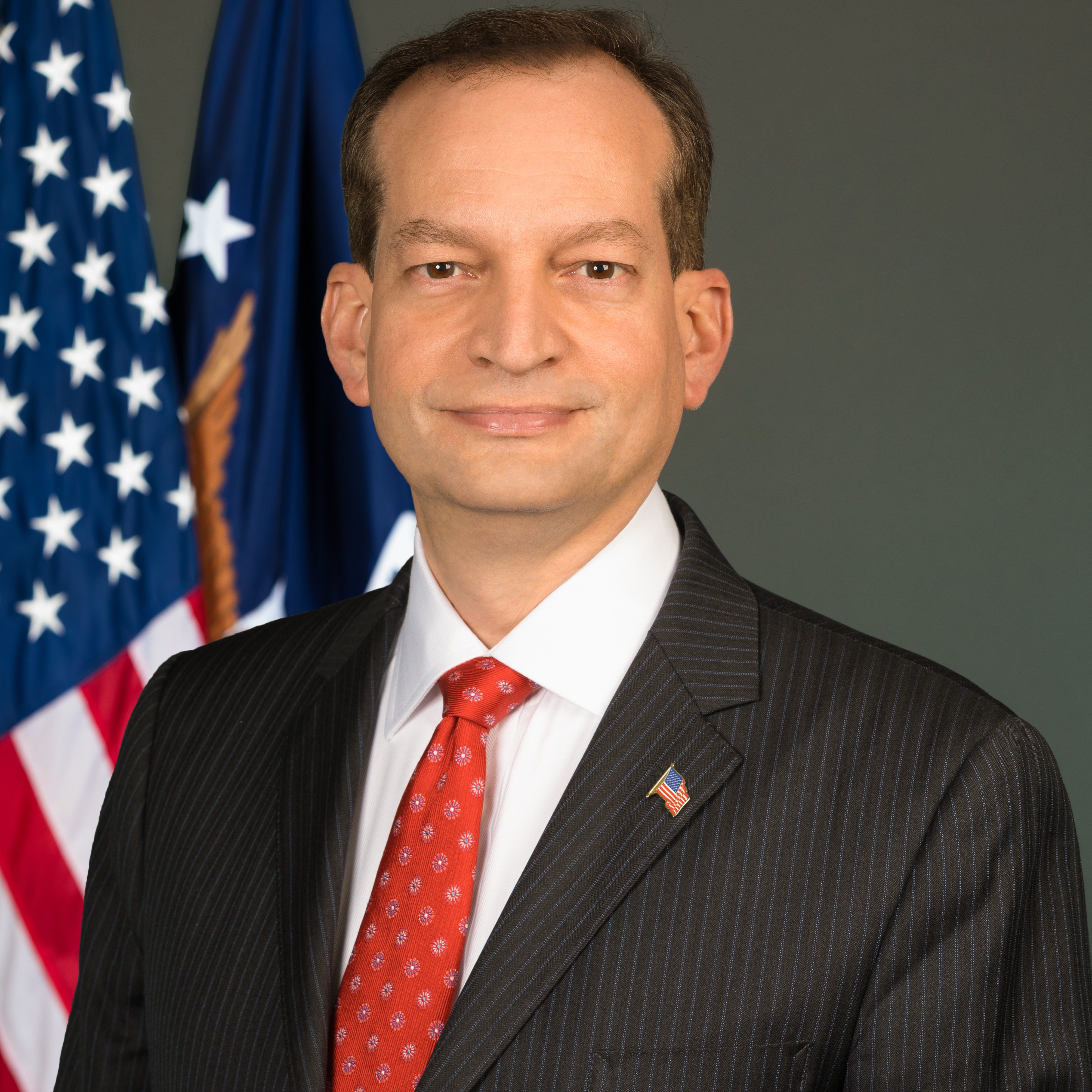
Former U.S. Attorney Alexander Acosta who worked through back channels to reach and agreement not to prosecute Epstein of any crimes he committed between 2001 and 2007.
The NPA is particularly bizarre because federal prosecutors backed off of what could have a 60-count indictment. Instead, they agreed not to prosecute any crimes Epstein committed between 2001 and 2007 so long as Epstein pleaded guilty in the State of Florida’s criminal case to one charge of soliciting prostitution.
The U.S. government expressly agreed not to prosecute Epstein for any offenses he may have committed between 2001 and 2007. All this was done in the dark, without any involvement of Epstein’s victims—in clear violation of their rights.
Epstein resists entering a plea agreement with Florida state prosecutors
Notwithstanding Epstein’s NPA with federal prosecutors, he did not immediately plead guilty in the Florida case as he was required to. Instead, over the next nine months, Epstein’s attorneys tried to change the terms of the NPA and invalidate it. Meanwhile, state prosecutors were rapidly approaching the 2008 trial date for its solicitation-of-prostitution case against Epstein.
Federal prosecutors empanel a new grand jury
Although Acosta had already entered into an NPA with Epstein in September 2007, Epstein failed to comply with its terms. In the meantime, FBI agents continued to investigate Epstein. And in 2008, a new federal grand jury was empaneled and began issuing subpoenas, including one to Epstein.
Ken Starr pressures No. 2 Official at the DOJ
After Epstein received a subpoena from the new grand jury, Ken Starr went to work and began pressuring the DOJ to end the investigation and new federal prosecution of Epstein in its entirety.
On May 19, 2008, Ken Starr and Joe D. Whitley sent their first letter to then-Deputy Attorney General Mark Filip.2 They pressured him to shut down the federal investigation of Epstein.
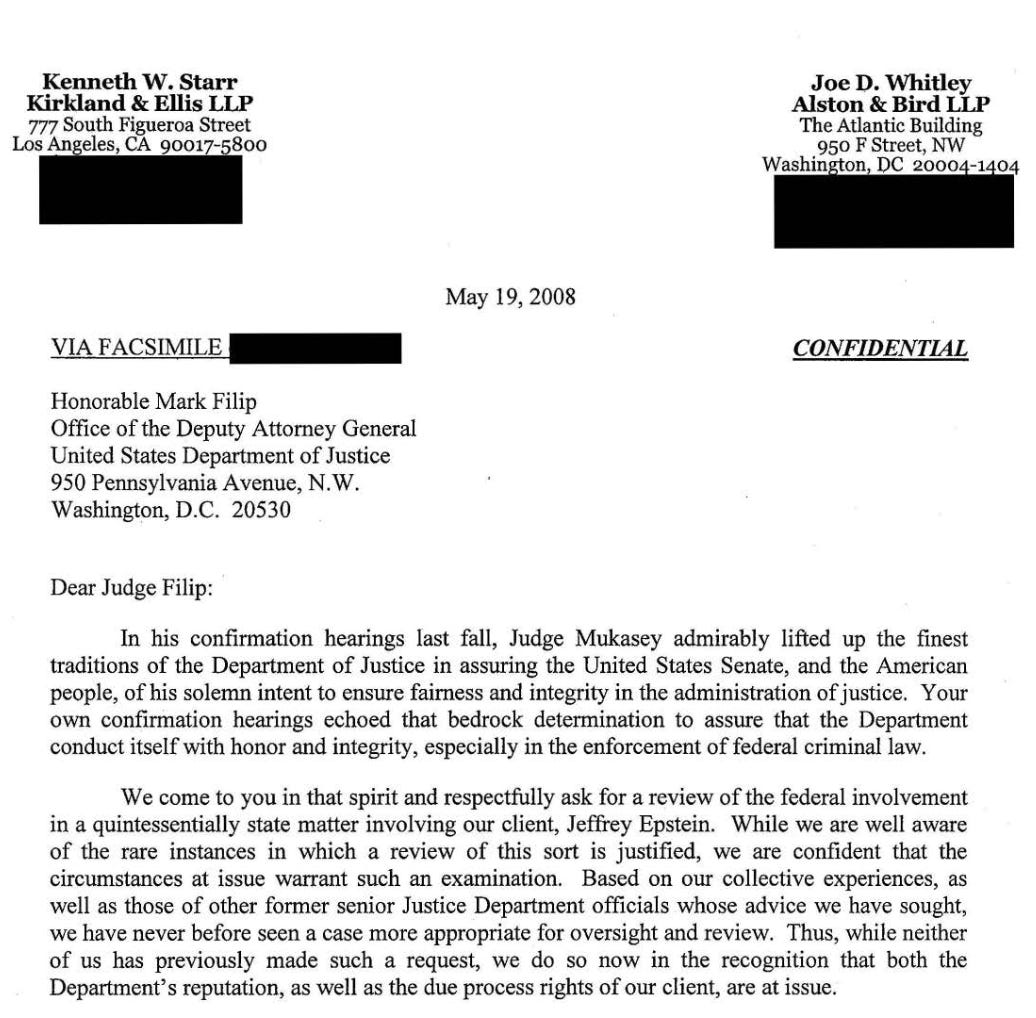
Starr argued that Epstein’s conduct was purely “local” to Florida and involved only solicitation.
Starr insinuated that officials from the U.S. Attorney’s Office (USAO) in Miami, while investigating the matter, had engaged in prosecutorial misconduct that gave rise to an appearance of impropriety.
Starr pointed out that Acosta had even requested that the DOJ investigate for prosecutorial misconduct surrounding the Epstein investigation.
Specifically, Acosta had requested that the DOJ’s Child Exploitation and Obscenity Section (CEOS) determine whether it would be an abuse of his own discretion to proceed with a criminal case against Epstein.
Ultimately, CEOS determined it was not. CEOS effectively gave Acosta the green light to prosecute Epstein.
But Starr continued to pressure the DOJ into discontinuing all federal involvement. Starr insisted that the feds back off and let Florida’s prosecutors resolve the solicitation matter.
Ken Starr sends another letter to Deputy AG Filip
On May 27, 2008, Starr sent a follow-up letter to Deputy AG Filip, urging him to “conduct an independent review of the proposed federal prosecution” of Epstein. At this point, Epstein remained in violation of the NPA, which required him to plead guilty in the Florida case for solicitation.
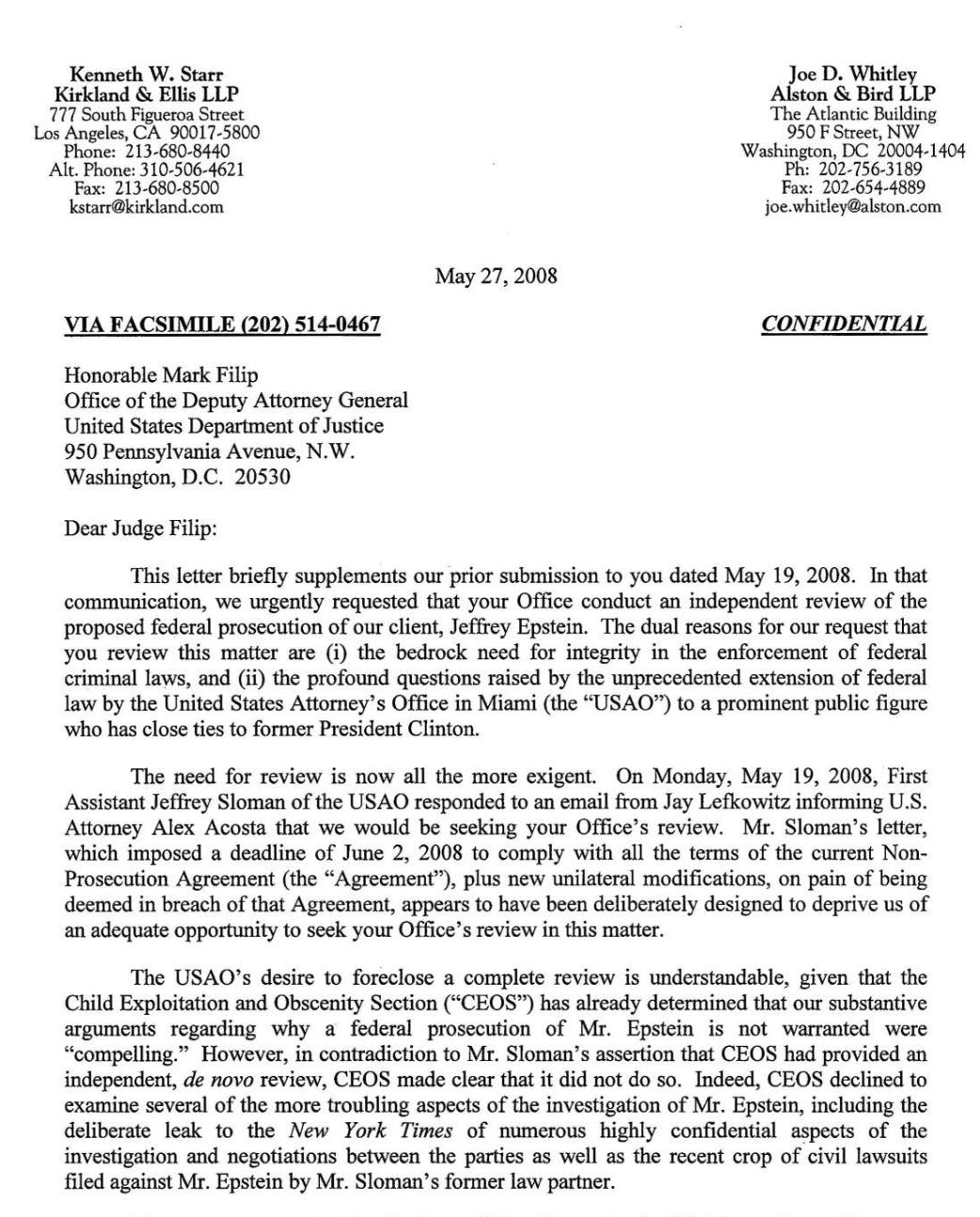
On June 19, 2008, Starr sent a third letter to the DOJ, this time to John Roth, Esq., then-Principal Associate Deputy Attorney General. Starr thanked him for the opportunity to explain why the federal prosecution of Epstein was unwarranted. Starr’s letter reveals he was pressing the federal government in every direction. Starr had also pressured CEOS and the USAO for the Southern District of Florida to stop prosecuting Epstein.
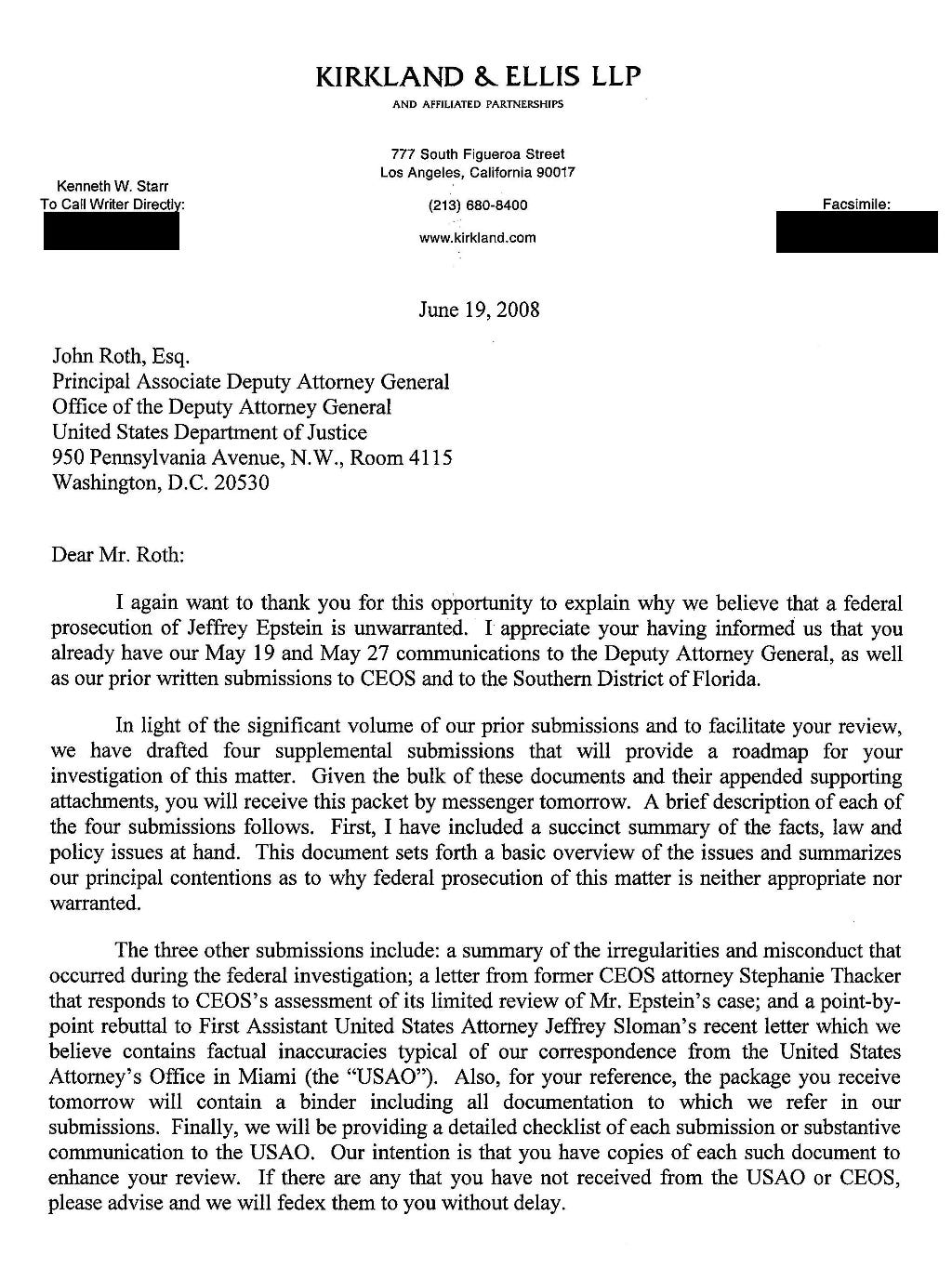
“[W]e have drafted four supplemental submissions that will provide a roadmap for your investigation of this matter. Given the bulk of these documents and their appended supporting attachments, you will receive this packet by messenger tomorrow,” Starr wrote.
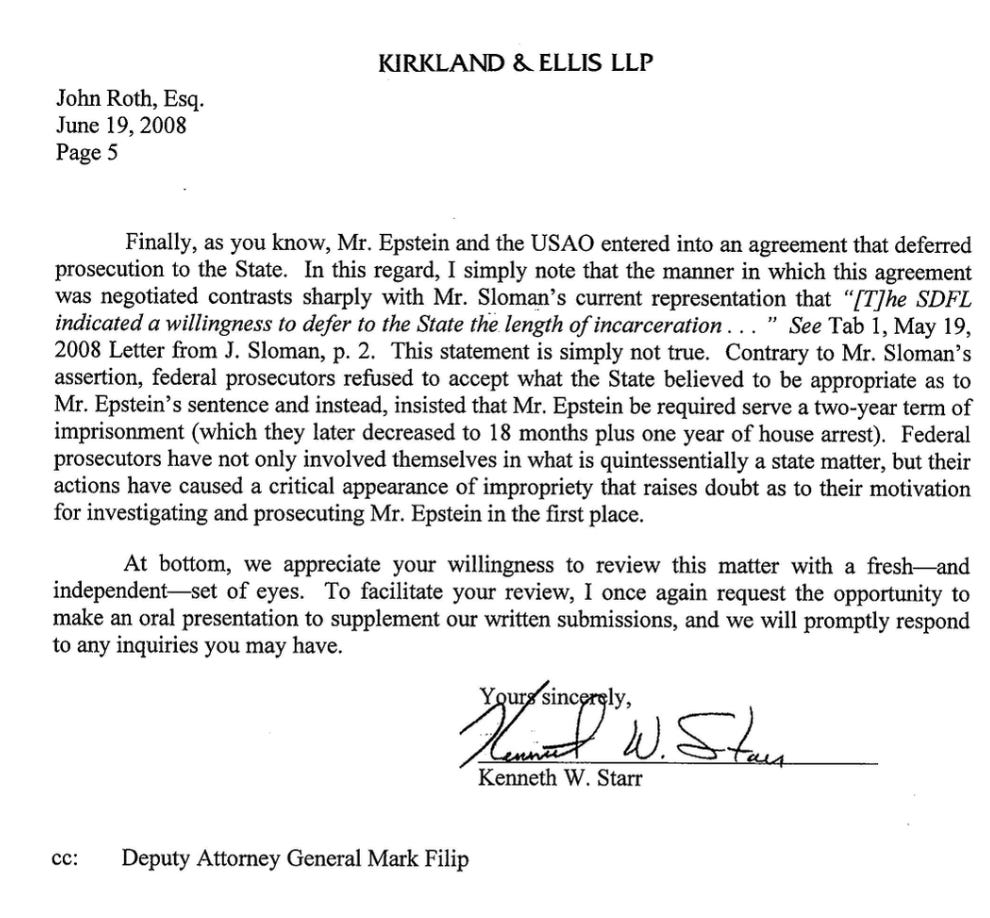

[Above] Screenshot of the current landing page for the law firm of Kirkland & Ellis, which advertises its pro bono work as “Supporting Children and Families.”
On June 23, 2008, then-Deputy AG Filip, who is now a partner at Kirkland & Ellis, informed Starr he would not intervene in the matter. Thereafter, Epstein finally agreed to fulfill his end of the NPA and plead guilty to soliciting a prostitute.
Epstein pleads guilty and the NPA takes effect
As a result, on June 30, 2008, Epstein finally appeared in a state court to plead guilty to solicitation and began serving his sentence. Once the plea was entered in 2008, the NPA’s federal immunity took effect.
The Aftermath
On July 7, 2008, a victim of Epstein filed a federal case under the Crime Victims’ Rights Act, 18 U.S.C. § 3771 (“CVRA”), because Acosta failed to consult with the victims in reaching the NPA with Epstein. (Jane Doe v. United States (SDFL) Case No. 08-80736-CIV-MARRA.) In fact, Acosta withheld the NPA from the victims until the federal judge in Jane Doe v. United States ordered the USAO to turn it over (subject to a protective order keeping it sealed from the public).3
After only three months in jail, the Palm Beach County Sheriff’s Office permitted Epstein to leave on work release so that he could spend 12 hours a day working on his own company.
In 2009, Acosta resigned from the U.S. Attorney’s Office and became dean of Florida International University College of Law. In 2017, Trump nominated Acosta to be Secretary of Labor.
The sweetheart deal held for more than a decade. Then, in November 2018, the Miami Herald’s “Perversion of Justice” series put Epstein’s victims and the NPA back in the headlines.
In February 2019, U.S. District Judge Kenneth Marra ruled in the CVRA case that federal prosecutors had broken the law by concealing the NPA from Epstein’s victims. The victims had waited more than ten years for that ruling.
On July 6, 2019, federal agents arrested Epstein at Teterboro Airport. Federal prosecutors in Manhattan charged him with sex trafficking of minors, the kind of case the Southern District of Florida had drafted and shelved in 2007. Six days later, Acosta resigned as Secretary of Labor. On August 10, 2019, Epstein was found dead in his cell at the Metropolitan Correctional Center before he could stand trial.
In November 2020, the DOJ’s Office of Professional Responsibility completed its review of the Epstein NPA. It concluded that Acosta had exercised “poor judgment” in resolving the case through the NPA, although it stopped short of finding professional misconduct.
Ken Starr died in 2022. He never publicly addressed his letters urging the Justice Department to walk away from the Epstein case.
Mark Filip, the Deputy Attorney General who received Starr’s first two letters, is now a partner at Kirkland & Ellis. That is the same firm whose website advertises its commitment to “Supporting Children and Families.”
The victims never got a federal trial. What remains is the paper trail, including three letters from one of America’s most famous prosecutors arguing that Jeffrey Epstein’s crimes were a local matter.
Kenneth Starr was a federal judge and prominent lawyer who was appointed as independent counsel to investigate the Whitewater controversy. After four years of investigation, Starr completed his report, in which he concluded that then-President Bill Clinton had lied under oath in a deposition in a civil lawsuit when he stated he did not have “sexual relations” with White House intern Monica Lewinsky. This served as a basis for the eventual impeachment of Bill Clinton. Starr went on to work at Kirkland & Ellis. Starr was also the dean of Pepperdine University School of Law from 2004 through 2010. In 2020, Starr helped represent Donald Trump during his first impeachment. Starr died in 2022.
At the time, Mark Filip had recently been appointed by George W. Bush as the United States Deputy Attorney General. Before that, he served four years as a federal judge for the Northern District of Illinois. Today, he is a partner at Kirkland & Ellis, LLP.
In 2015, Virginia Roberts Giuffre filed a motion to join the CVRA lawsuit as Jane Doe 3. In Giuffre’s motion for joinder, she alleged that Epstein had trafficked her, while she was a minor, to his attorney Alan Dershowitz and Prince Andrew.
The source documents used for this article are provided below to paid subscribers.
